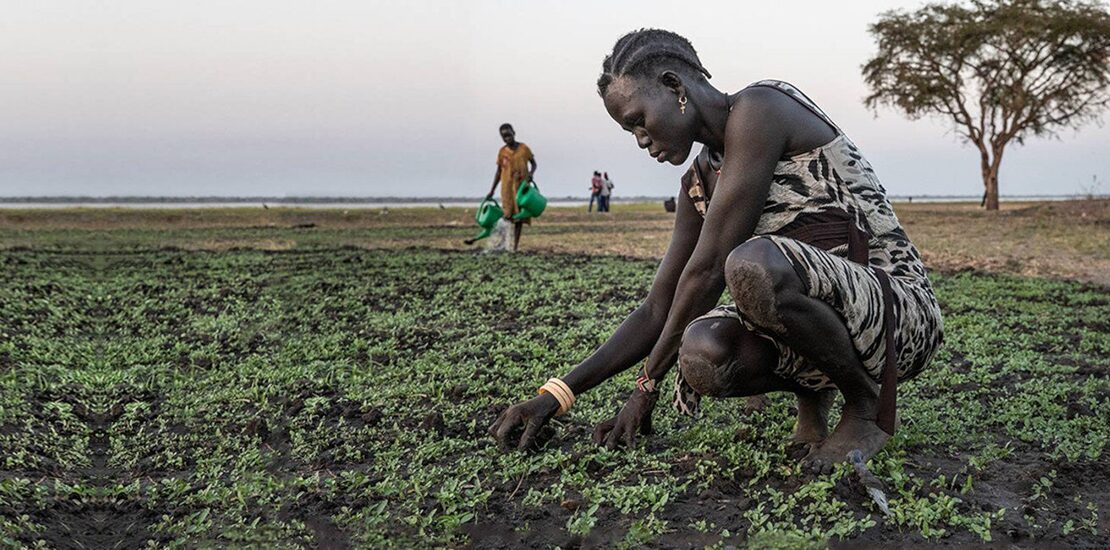
South Sudan is a country rich of natural resources, has very fertile soils and enough waters, a and very youthful, but food production is still very low in the country. This is worsened by the displacement of communities by violent conflicts and natural disasters caused by the climate change – most especially the devastating flooding in Greater Upper Nile and Greater Bahr El Ghazal regions.
The Integrated food security Phase Classification (IPC) released quarterly by the UN (WFP, FAO and UNOCHA) indicated that more than 5.8 million South Sudanese face acute food insecurity. Partly due to persisting conflicts among communities and high level of insecurity and devastating flooding in some parts of the country, and partly due to lack of good teachings in the areas of agriculture; local communities are not able to produce food. Even subsistence farming does not yield enough food that can keep the family surviving till the next harvest season.
This has resulted into widespread food insecurity in many parts of the country, challenging the humanitarian agencies to make very costly responses to the situation. CEDAR plays a big role in teaching communities modern methods of agricultural production to boost their subsistence farming.
CEDAR also engage communities on commercialisation and industrialisation of fisheries, livestock and forestry.
Agricultural activities in communities include among others, the following:
Crop production including cereal, vegetables and cash crops like coffee, tea, tobacco, cotton, etc
Poultry keeping and breeding to improve household livelihoods
Animals farm; like cows, goats, sheep, pigs, donkeys and camels.
Fisheries: training local fishermen on techniques of commercial fishing and provided with nets. Fish farming through creation of fish ponds where people are taught ways of also keeping fish in their own controlled waters and catch them when they are big and sell to earn money.
Ox ploughs: As part of boosting crop production, communities are taught to make use of their cows by making them to work and help ploughing gardens.
CEDAR also work with communities to engage in livelihood activities including small business enterprises, forming cooperatives societies which can be supported by micro-finance credit services, attending vocational trainings to equip them with skills to start-up businesses on carpentry, tailoring, bakery, catering and beauty shops.
South Sudan is a country rich of natural resources, has very fertile soils and enough waters, a and very youthful, but food production is still very low in the country. This is worsened by the displacement of communities by violent conflicts and natural disasters caused by the climate change – most especially the devastating flooding in Greater Upper Nile and Greater Bahr El Ghazal regions.
The Integrated food security Phase Classification (IPC) released quarterly by the UN (WFP, FAO and UNOCHA) indicated that more than 5.8 million South Sudanese face acute food insecurity. Partly due to persisting conflicts among communities and high level of insecurity and devastating flooding in some parts of the country, and partly due to lack of good teachings in the areas of agriculture; local communities are not able to produce food. Even subsistence farming does not yield enough food that can keep the family surviving till the next harvest season.
This has resulted into widespread food insecurity in many parts of the country, challenging the humanitarian agencies to make very costly responses to the situation. CEDAR plays a big role in teaching communities modern methods of agricultural production to boost their subsistence farming.
CEDAR also engage communities on commercialisation and industrialisation of fisheries, livestock and forestry.
Agricultural activities in communities include among others, the following:
Crop production including cereal, vegetables and cash crops like coffee, tea, tobacco, cotton, etc
Poultry keeping and breeding to improve household livelihoods
Animals farm; like cows, goats, sheep, pigs, donkeys and camels.
Fisheries: training local fishermen on techniques of commercial fishing and provided with nets. Fish farming through creation of fish ponds where people are taught ways of also keeping fish in their own controlled waters and catch them when they are big and sell to earn money.
Ox ploughs: As part of boosting crop production, communities are taught to make use of their cows by making them to work and help ploughing gardens.
CEDAR also work with communities to engage in livelihood activities including small business enterprises, forming cooperatives societies which can be supported by micro-finance credit services, attending vocational trainings to equip them with skills to start-up businesses on carpentry, tailoring, bakery, catering and beauty shops.
CEDAR, a non-profit in South Sudan since 2016, aids disaster-stricken communities, fostering dialogue for lasting solutions. Our focus on peace enables sustainable development in healed, resilient communities.
CEDAR, a non-profit in South Sudan since 2016, aids disaster-stricken communities, fostering dialogue for lasting solutions. Our focus on peace enables sustainable development in healed, resilient communities.